
5 Warehouse Layouts to Cut Picking Time by 20%
Author: Christopher Yip | 5 min read | Published: 8 April 2026
Table of Contents

In the competitive landscape of Malaysian wholesaling, efficiency isn't just a goal; it's a survival requirement. For most wholesalers, their order picking accounts for approximately 50% to 55% of total warehouse operating costs. The primary culprit? Travel time.
That’s why optimizing your warehouse layout design is so critical. By reducing the physical distance pickers need to travel, you can cut picking times by 20% or more.
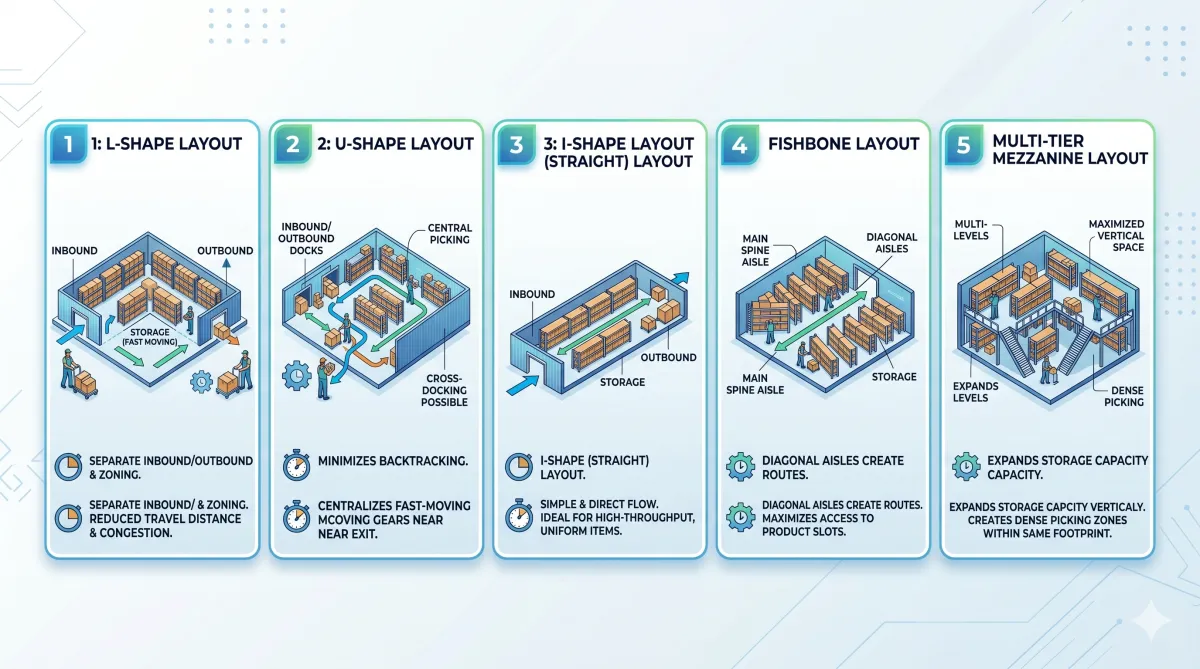
The Importance of Warehouse Layout Design for Malaysian Wholesalers
For wholesalers in Malaysia, industrial land prices in areas like Selangor and Penang have surged, making space utilization more critical than ever. However, simply "cramming" more stock into a building often leads to "congestion costs." When aisles are too narrow or the flow is illogical, warehouse productivity plummets.
An effective warehouse layout design follows the "Principle of Flow," ensuring that goods move in a one-way journey. This prevents "backtracking"—the phenomenon where pickers or forklifts must move against the flow of traffic, causing safety risks and delays. Whether you are dealing with FMCG, electronics, or automotive parts, the right layout acts as the "operating system" for your physical space.
Top 5 Warehouse Layouts to Boost Warehouse Productivity
1. The U-Shaped Layout: The Gold Standard for Versatility
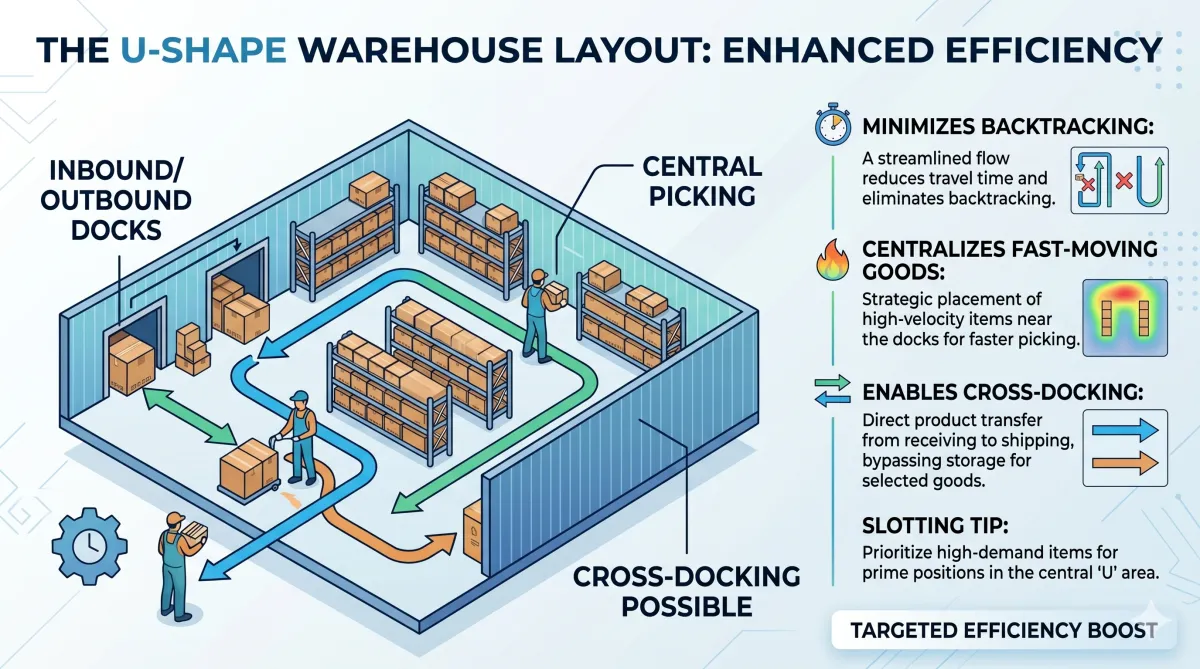
The U-shaped layout is the most common design and is particularly effective for SMEs and medium-sized wholesalers in Malaysia. In this configuration, the receiving and shipping docks are located next to each other on the same side of the building.
How it works: Goods enter through receiving, move into the "bottom" of the U for storage, and then move back up the other side to shipping
Why it cuts picking time: It allows for shared resources (dock staff and equipment) and places high-velocity items (fast-movers) closest to the docks, minimizing the distance pickers need to travel for 80% of your orders.
2. The I-Shaped (Flow-Through) Layout: High-Volume Mastery
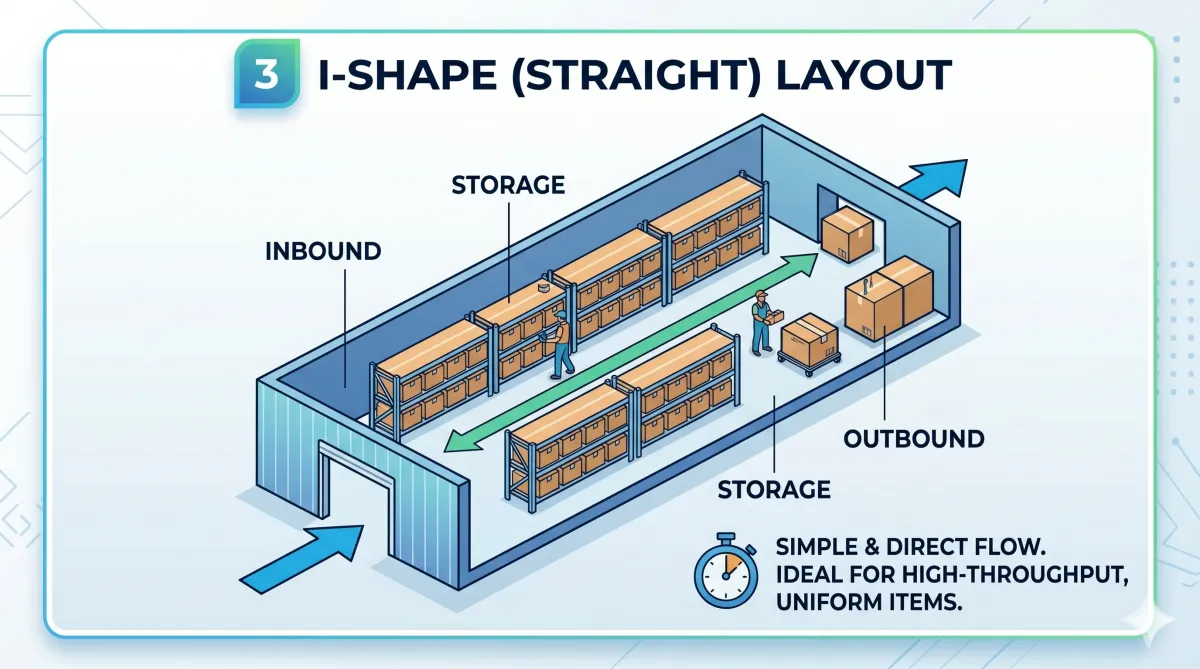
Ideal for large-scale wholesalers with high volume and high turnover, the I-shaped layout utilizes a "straight-line" flow. Receiving is on one end of the building, and shipping is on the opposite end.
How it works: Products move in a linear path from one side to the other.
Why it cuts picking time: It completely eliminates the risk of "traffic jams" between inbound and outbound goods. For warehouses that utilize cross-docking (moving goods directly from receiving to shipping with minimal storage), this layout is unbeatable for speed.
3. The L-Shaped Layout: Corner Optimization
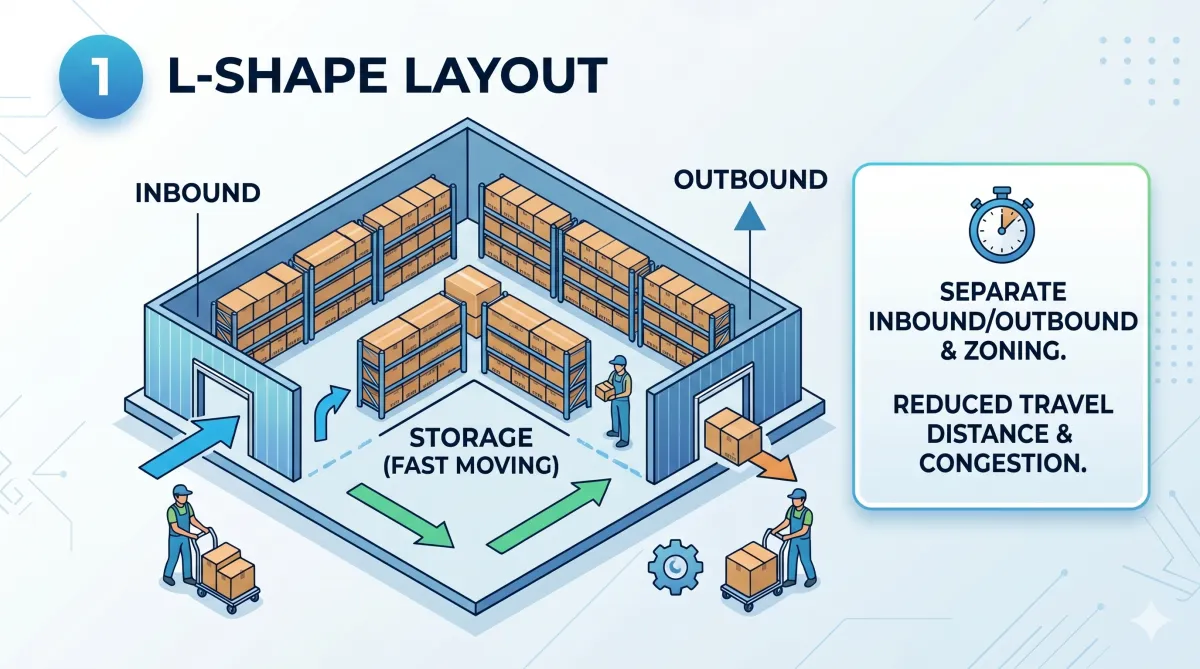
Sometimes dictated by the physical shape of the building, the L-shaped layout places receiving on one side and shipping on an adjacent side (at a 90-degree angle).
How it works: Storage is concentrated in the "corner" or the elbow of the L.
Why it cuts picking time: This layout creates distinct zones that reduce interference. By placing the most frequently picked items near the "inner" corner of the L, you create a shortcut for pickers, significantly reducing the "pick path" distance.
4. The Fishbone Layout: The Speed Specialist
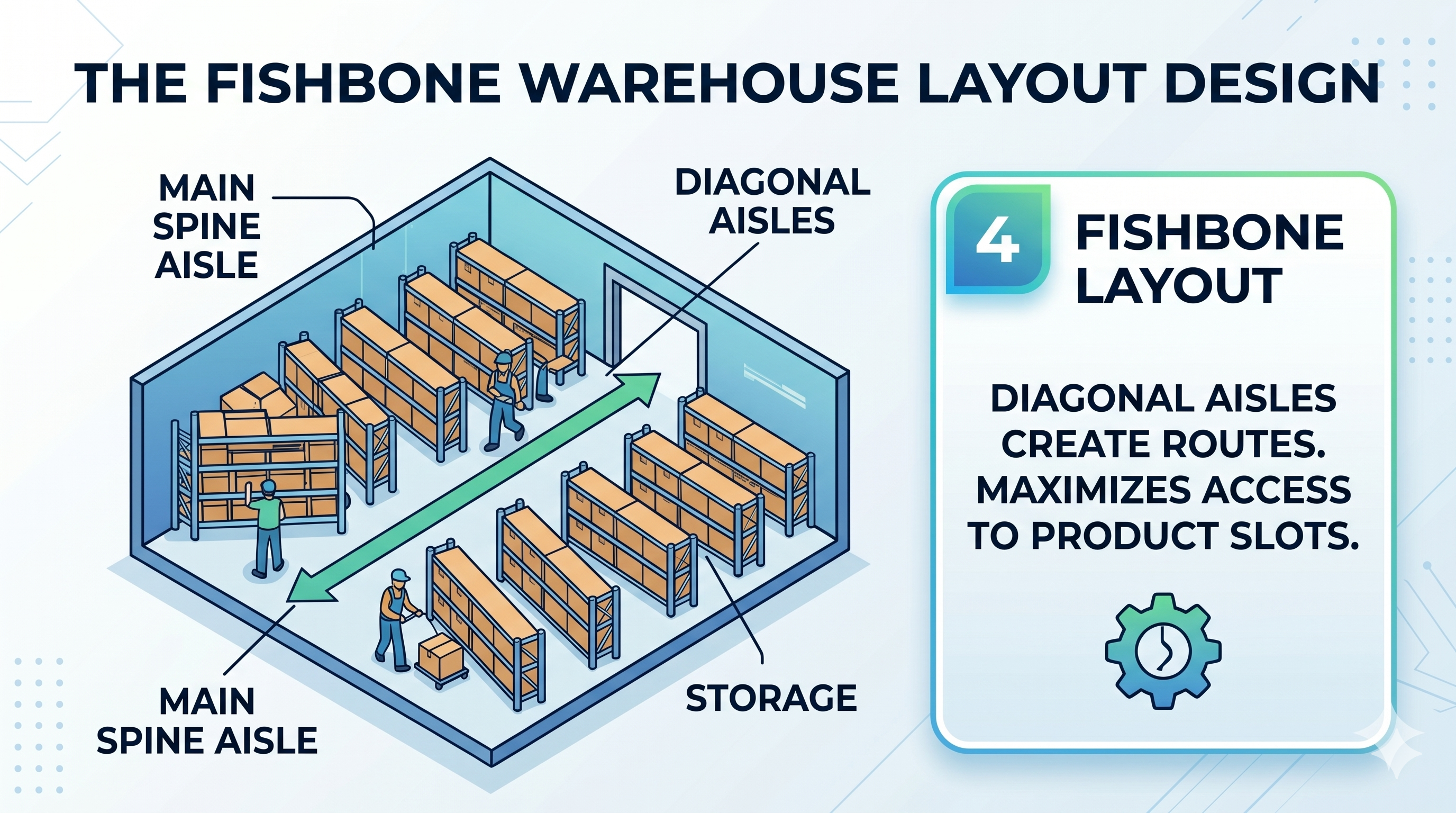
A more advanced configuration, the fishbone layout uses diagonal aisles instead of the traditional 90-degree rectangular grid.
How it works: Aisles are angled towards the dispatch area, resembling the bones of a fish.
Why it cuts picking time: Research into warehouse geometry shows that diagonal travel allows pickers to take the "hypotenuse" path rather than two sides of a triangle. This can reduce travel time by up to 10-15% on its own, which, when combined with smart slotting, easily clears the 20% improvement mark.
5. Multi-Tier Mezzanine Layout: Maximizing Vertical Space
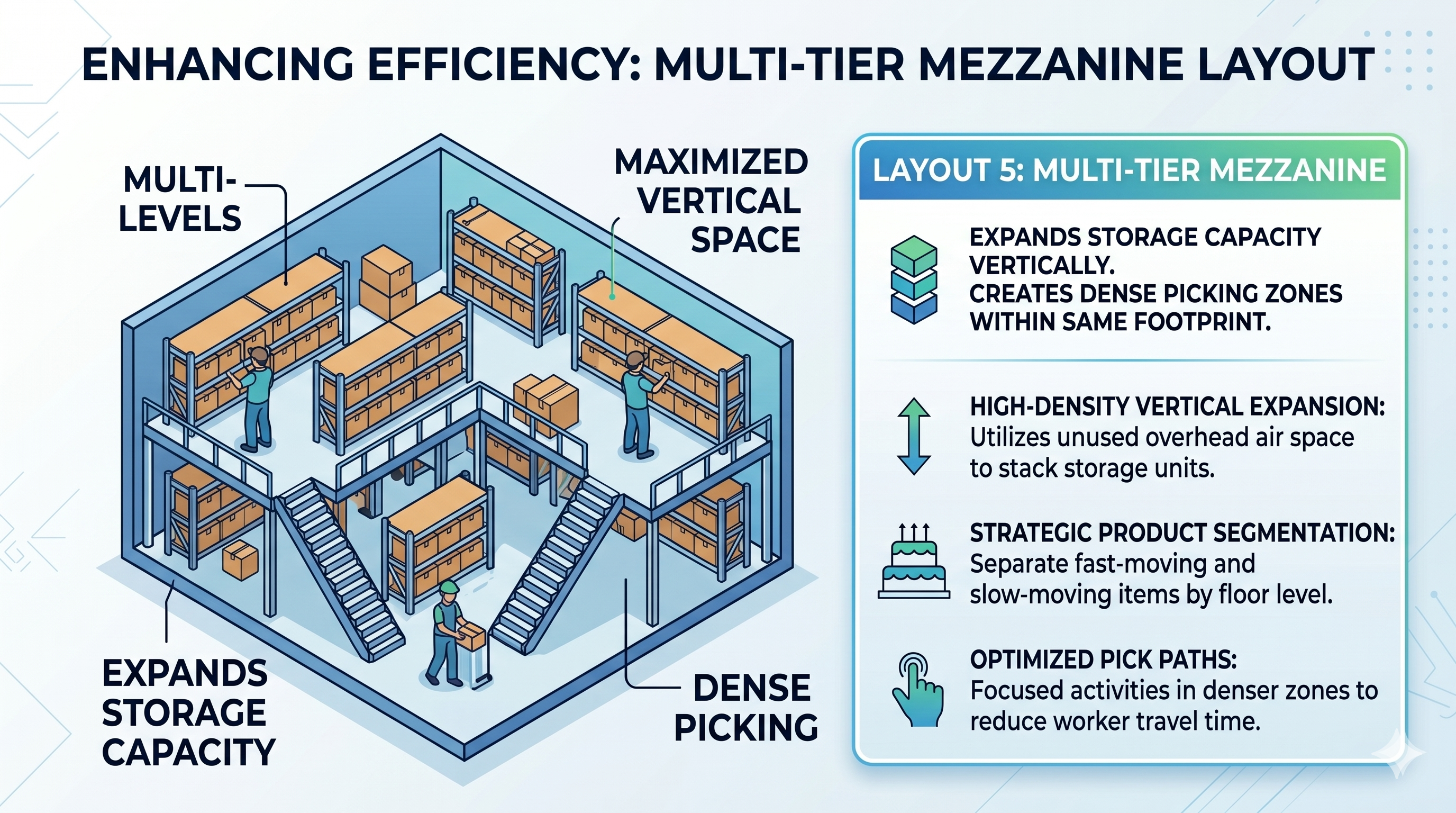
In Malaysian urban centers where horizontal expansion is impossible, the mezzanine layout is the answer. This involves building "up" rather than "out."
How it works: Steel platforms are installed to create second or third levels of picking space.
Why it cuts picking time: It keeps the footprint small. Instead of a picker walking 100 meters across a massive floor, they might only walk 20 meters on a mezzanine levels connected by vertical lifts or chutes. It effectively doubles or triples your picking locations within the same "travel radius."
Improving Order Picking Through Strategic Slotting
A layout is only as good as the inventory logic within it. To truly achieve a 20% reduction in picking time, you must pair your warehouse layout design with ABC Analysis.
A-Items (Fast Movers): These should be placed in the "Golden Zone" (waist-to-shoulder height) and closest to the shipping docks.
B-Items (Medium Movers): Placed further back or on higher/lower shelves.
C-Items (Slow Movers): Placed in the furthest corners or highest racks.
By combining an I-shaped layout with ABC slotting, a Malaysian wholesaler can ensure that pickers spend 80% of their time in just 20% of the warehouse space.
Implementation Checklist: 3 Steps to Success
1. Map Your Current Flow: Use "Spaghetti Diagrams" to trace the path a picker takes for a standard order. If the lines cross frequently, you have a bottleneck.
2. Test Before You Invest: Before bolting racks to the floor, use floor tape to mark out your new warehouse layout. Run "mock picks" to see if the new flow feels intuitive for your staff.
3. Leverage a WMS: A Warehouse Management System (WMS) is the brain that runs the layout. In 2026, many Malaysian wholesalers are integrating WMS with basic automation to further optimize picking sequences.
Frequently Asked Questions (FAQ)
What is the best warehouse layout for a small wholesaler in Malaysia?
The U-shaped layout is generally best for small-to-medium wholesalers. It is cost-effective, utilizes a single dock area for both receiving and shipping, and is the easiest to manage with a smaller workforce.
How does warehouse layout design impact safety?
A poor layout leads to cluttered aisles and "blind spots." An optimized design creates dedicated paths for forklifts and separate walking zones for pickers, significantly reducing the risk of collisions and workplace injuries.
Can I improve warehouse productivity without moving my racks?
Yes. You can start with "re-slotting." Move your most popular items closer to the packing stations. Even without changing the physical aisles, optimizing where items sit can cut travel time by 10-15%.
What is the "Golden Zone" in order picking?
The Golden Zone refers to the storage area between a picker's waist and shoulders. Items stored here can be picked without bending or reaching, which is faster and reduces physical fatigue.
Conclusion
Optimizing your warehouse layout is one of the highest-ROI investments a wholesaler can make. By choosing between a U-shaped, I-shaped, L-shaped, Fishbone, or Mezzanine design, you aren't just moving shelves, you are engineering speed. Reducing travel time by 20% doesn't just mean faster shipments; it means lower labor costs, fewer errors, and a more scalable business. If you are a wholesaler in Malaysia looking to stay ahead in 2026, start by looking at your floor plan. Your next competitive advantage is literally under your feet.
Boost Your Business Effortlessly Today!