
The 2026 Forklift Safety Checklist for Malaysia Wholesaler
Author: Christopher Yip | 10 min read | Published: 17 April 2026
Table of Contents

In the fast-paced world of Malaysian wholesale and logistics, forklift safety is the cornerstone of a productive and legally compliant warehouse operation. As we navigate 2026, the Department of Occupational Safety and Health (DOSH) has tightened enforcement on the Occupational Safety and Health (Amendment) Act, making rigorous safety protocols more critical than ever. A comprehensive safety checklist ensures that your operators return home safely while your business avoids costly downtime and legal penalties.
This guide provides an exhaustive 2026 checklist tailored for wholesalers operating in Malaysia, integrating the latest technological advancements and regulatory requirements to ensure your warehouse safety standards are world-class.
Why Forklift Safety is Non-Negotiable in 2026
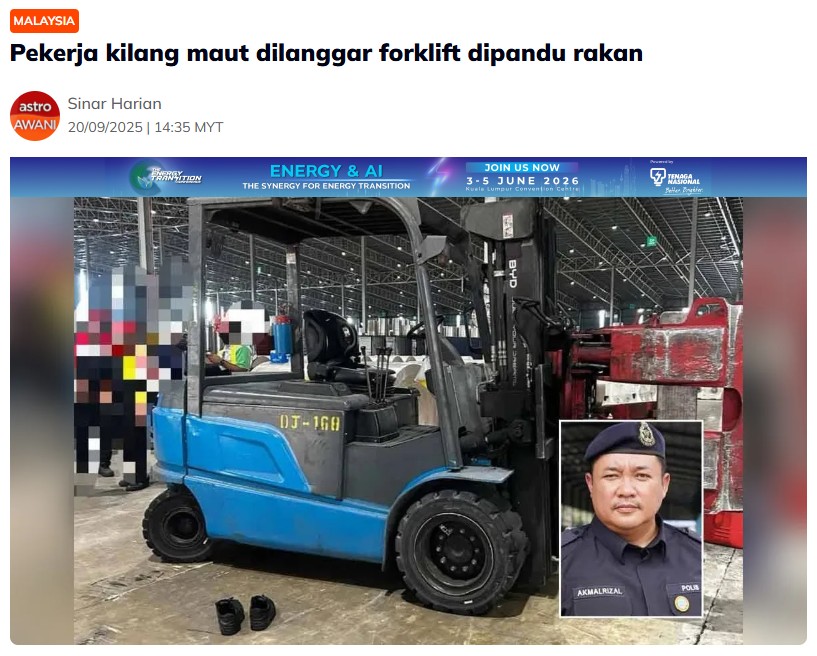
For a Malaysian wholesaler, the forklift is the workhorse of the facility. However, it is also one of the most dangerous pieces of equipment if mismanaged. With the 2026 industrial landscape shifting toward higher racking systems and increased automation, the margin for error has narrowed.
The Cost of Non-Compliance with DOSH
In Malaysia, DOSH (Jabatan Keselamatan dan Kesihatan Pekerjaan - JKKP) mandates that all material handling equipment be maintained in "safe working condition." Under the latest amendments to the OSH Act, employers can face significantly higher fines and even imprisonment for negligence that leads to workplace accidents. Beyond the legalities, a single forklift incident can disrupt your entire supply chain, leading to damaged inventory and decreased employee morale.
The Rise of Smart Warehouse Operation
By 2026, many Malaysian warehouses have integrated AI-driven telematics and proximity sensors. While these technologies enhance safety, they do not replace the need for a manual, disciplined inspection routine. A physical checklist remains the primary line of defense against mechanical failure and human error.
Part 1: The Pre-Operational Forklift Safety Checklist
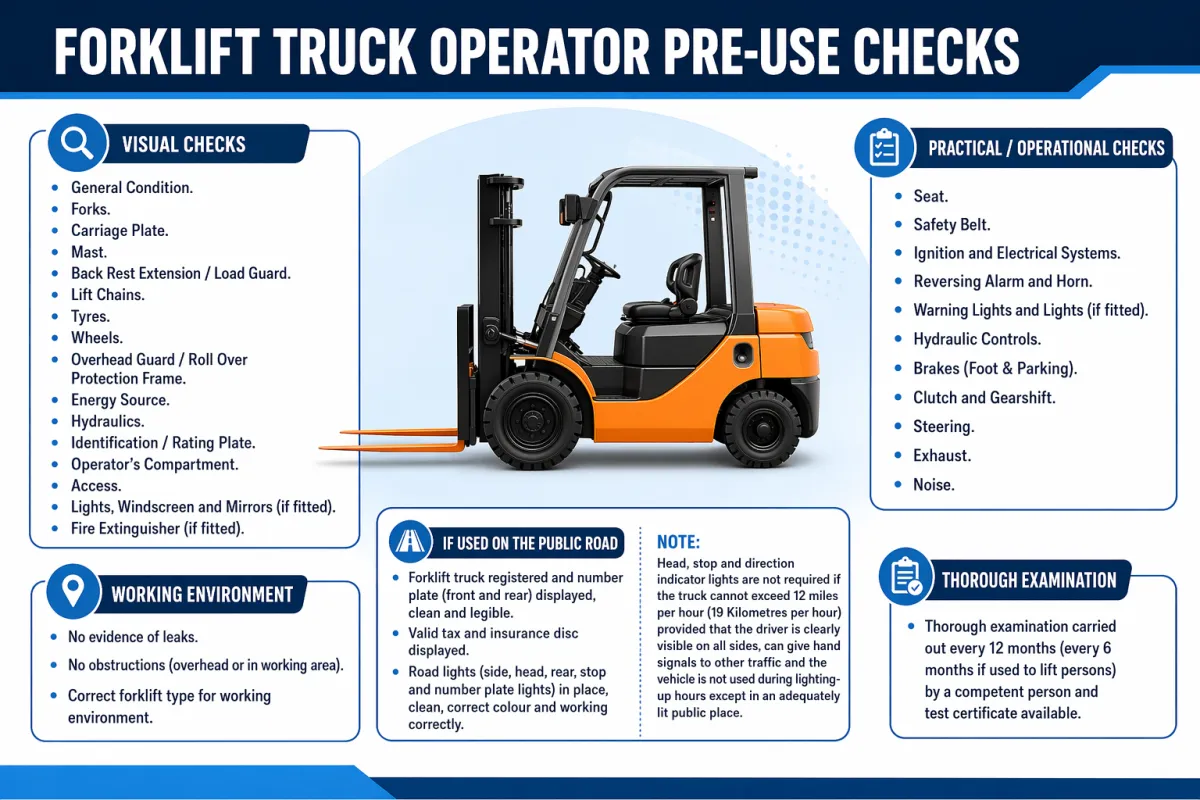
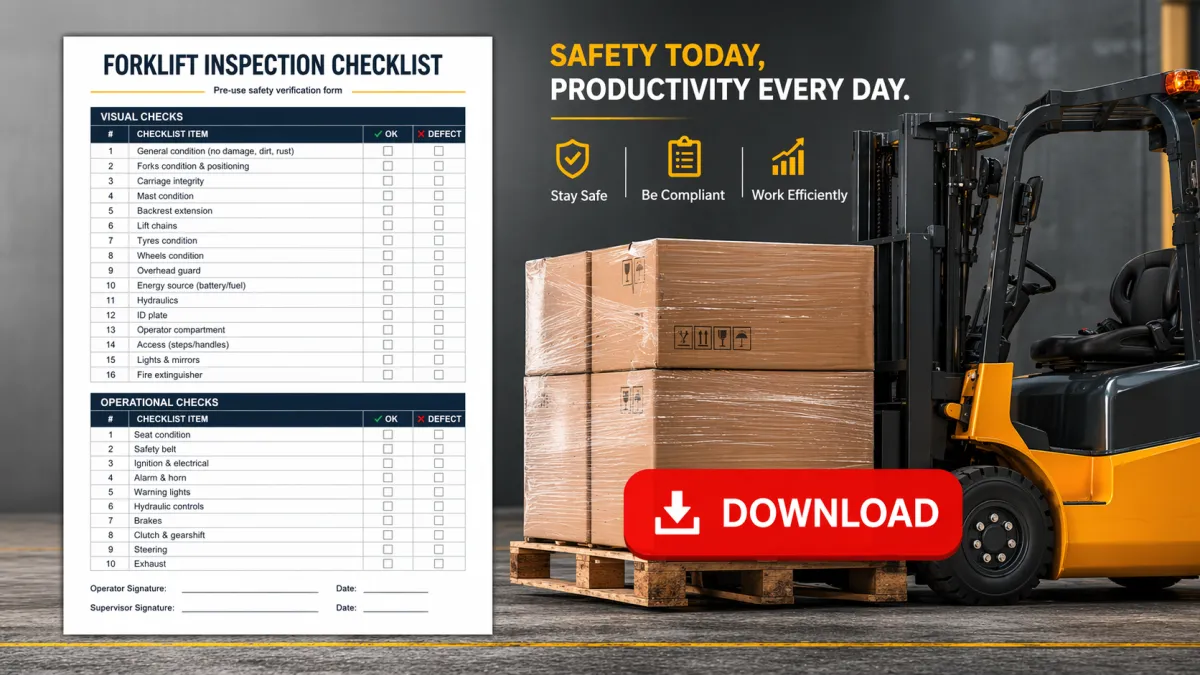
Before any shift begins, a pre-operational inspection must be conducted. This is a mandatory requirement for warehouse safety and ensures that the vehicle is fit for the day's tasks.
1. Visual Inspection (The Walk-Around)
Fluid Levels: Check hydraulic oil, engine oil, and coolant. For electric forklifts, ensure the battery water level is sufficient and there is no "blooming" or corrosion on terminals.
Tires and Wheels: Inspect for "chunking" (missing pieces of rubber), cracks, or embedded debris. In 2026, many wholesalers use non-marking tires; ensure these haven't worn down past the safety line.
Forks and Mast: Look for cracks, bends, or unevenness in the forks. Ensure the carriage teeth are not worn and the load backrest is secure.
Hoses and Chains: Check for hydraulic leaks or "sweating" hoses. Lift chains should be lubricated and show no signs of stretching or rusted links.
2. Operational Testing (The "Key-On" Check)
Warning Devices: Test the horn, backup alarm, and strobe lights. In a busy Malaysian warehouse, these auditory and visual cues are vital for pedestrian safety.
Braking System: Test the service brake and the parking brake. The forklift should hold its position on a 15% grade.
Hydraulic Controls: Raise the forks to maximum height and tilt them fully forward and backward to ensure smooth movement without "shuddering."
Steering: Ensure the steering is responsive and there is no excessive "play" in the wheel.
Part 2: Enhancing Warehouse Safety Through Operational Protocols
A checklist is only effective if the environment in which the forklift operates is also regulated. For Malaysian wholesalers, this means managing high-traffic zones and narrow-aisle storage.
Training and Competency (The DOSH Requirement)
Every operator in your warehouse operation must be a "Competent Person" as defined by DOSH. This involves:
Valid Certification: Ensuring the operator has attended a DOSH-recognized forklift driving course.
Annual Refresher Training: In 2026, it is best practice to provide annual skill audits to correct "lazy habits" that develop over time.
Specific Model Familiarization: If you introduce new reach trucks or VNA (Very Narrow Aisle) forklifts, operators must be trained on those specific controls.
Environmental Safety Checks
Floor Conditions: Are there oil spills, loose shrink wrap, or uneven floor joints? Even a small puddle can cause a forklift to skid during emergency braking.
Lighting: Ensure that all areas of the warehouse, especially loading docks and high-racking aisles, are illuminated to at least 150 lux.
Signage: Malaysia's OSH guidelines require clear signage for speed limits (usually 5km/h indoors) and pedestrian walkways.
Part 3: Specialized 2026 Safety Considerations for Wholesalers
The wholesale sector in Malaysia has evolved. Your forklift safety checklist must evolve with it.
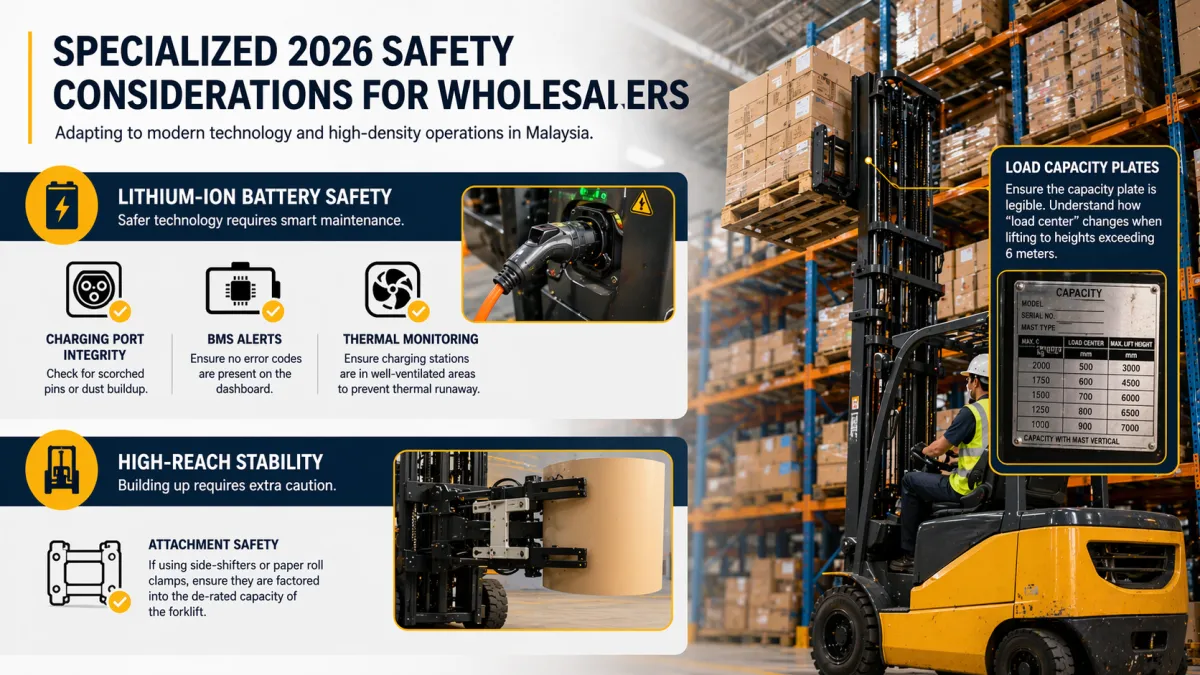
Lithium-Ion Battery Safety
As of 2026, lithium-ion forklifts have largely replaced lead-acid models in modern Malaysian warehouses. While safer, they require specific checks:
Charging Port Integrity: Check for scorched pins or dust buildup.
BMS (Battery Management System) Alerts: Ensure no error codes are present on the dashboard.
Thermal Monitoring: Ensure charging stations are in well-ventilated areas to prevent thermal runaway.
High-Reach Stability
With land prices in areas like Shah Alam and Port Klang rising, wholesalers are building "up."
Load Capacity Plates: Ensure the capacity plate is legible. Operators must understand how "load center" changes when lifting to heights exceeding 6 meters.
Attachment Safety: If using side-shifters or paper roll clamps, ensure they are factored into the de-rated capacity of the forklift.
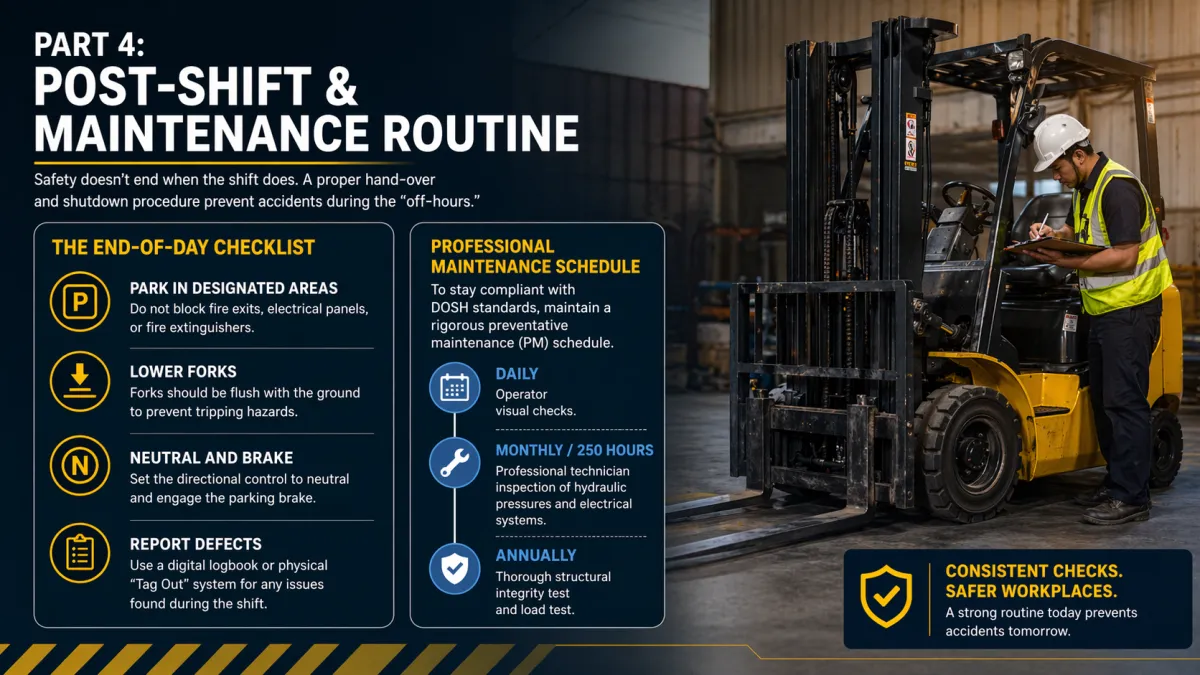
Part 4: Post-Shift and Maintenance Routine
Safety doesn't end when the shift does. A proper hand-over and shutdown procedure prevent accidents during the "off-hours."
The End-of-Day Checklist
Park in Designated Areas: Do not block fire exits, electrical panels, or fire extinguishers.
Lower Forks: Forks should be flush with the ground to prevent tripping hazards.
Neutral and Brake: Set the directional control to neutral and engage the parking brake.
Report Defects: Use a digital logbook or physical "Tag Out" system for any issues found during the shift.
Professional Maintenance Schedule
To stay compliant with DOSH standards, maintain a rigorous preventative maintenance (PM) schedule.
Daily: Operator visual checks.
Monthly/250 Hours: Professional technician inspection of hydraulic pressures and electrical systems.
Annually: Thorough structural integrity test and load test.
FAQ: Frequently Asked Questions about Forklift Safety in Malaysia
Does DOSH require a written daily checklist for forklifts?
Yes. Under the OSH (General Duties of Employers and Self-Employed Persons) Regulations, maintaining records of inspections is evidence of "due diligence." In the event of an audit or accident, these records are your primary legal defense.
What is the maximum speed for a forklift in a Malaysian warehouse?
While there is no single "law" for speed, DOSH guidelines and industry best practices suggest a maximum of 5 km/h in areas where pedestrians are present and 10 km/h in open, clear zones. Most 2026 models allow for electronic speed limiting.
How often should forklift operators be re-certified in Malaysia?
It is recommended to conduct a competency assessment every 2 years, or immediately following an "near-miss" incident. Staying updated with the latest warehouse operation standards is key to maintaining a safe environment.
Can a forklift be used to lift people if a cage is attached?
Only if the cage is a purpose-built, certified "man-basket" that is securely attached to the forks and the forklift is rated for such use. The operator must remain at the controls at all times, and the person in the cage must wear a safety harness.
Conclusion: Securing Your Warehouse Future
Staying compliant with DOSH and prioritizing warehouse safety protects your most valuable asset: your people. Don't wait for an accident to audit your processes. Start using this 2026 safety checklist today and lead the way in Malaysian industrial excellence.
Ready to modernize your B2B sales workflow?
Cut down on manual labor and reclaim your time with our automated ordering system. Built for the modern wholesaler.